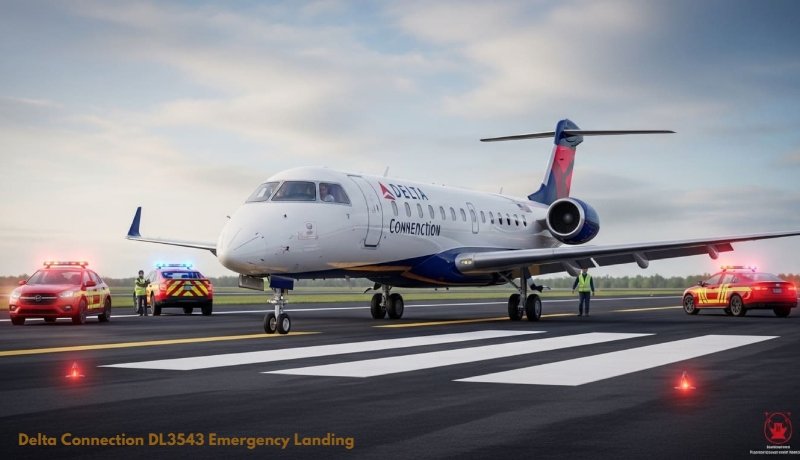
On July 7, 2025, a routine regional flight operated by Delta Connection — designated Flight DL3543 — made headlines when it declared an emergency shortly after takeoff and returned to its departure airport for an emergency landing. Although the news initially raised alarm among travelers and the general public, careful analysis reveals that this event was handled professionally, safely, and in accordance with aviation protocols. No injuries were reported, and the incident highlights how safety‑first practices in aviation protect passengers every day.
In this article, we’ll cover:
-
What happened on DL3543
-
The flight’s background and timeline
-
The technical issue that triggered the emergency
-
Safety procedures for emergency landings
-
Passenger experience
-
Aviation insights and takeaways
1. Delta Connection DL3543 — Flight Overview
Delta Connection DL3543 is a regional flight typically operated under the Delta Connection brand by one of Delta’s regional partners, often using smaller jets such as the Embraer E‑175. On July 7, 2025, the flight was scheduled to fly from Minneapolis–Saint Paul International Airport (MSP) to Chicago Midway International Airport (MDW).
| Flight Detail | Information |
|---|---|
| Flight Number | DL3543 |
| Operator | Delta Connection (operated by regional partner) |
| Aircraft Type | Embraer regional jet (likely Embraer 170/175) |
| Route | Minneapolis (MSP) ➝ Chicago (MDW) |
| Date of Incident | July 7, 2025 |
| Departure Airport | Minneapolis–Saint Paul International (MSP) |
| Status | Declared emergency & returned to MSP |
| Passengers & Crew | Safe, no injuries |
| Outcome | Emergency landing completed safely |
2. The Timeline of Events
Here is how the event unfolded on the day of the incident:
Pre‑Flight and Takeoff
-
The aircraft departed MSP as scheduled in the early afternoon.
-
Initial climb was normal, and passengers settled in for what would normally be a short regional hop.
Recognition of a System Warning
Shortly after reaching cruising altitude — typically between 15,000 and 25,000 feet for such flights — the flight crew received an alert associated with the pressurization system. Modern commercial aircraft are equipped with advanced sensors that continuously monitor multiple systems. In this case, the cabin pressurization monitoring system signaled an abnormal condition.
Emergency Declaration
Rather than risk continuing, the pilots declared an emergency using transponder code 7700, which notifies air traffic control that an aircraft is in a situation requiring priority handling. Instructions were relayed immediately to coordinate a return.
Turnaround and Return
-
The aircraft executed a controlled turn back to MSP.
-
Air traffic control cleared the flight to return on an approach to the runway.
-
On the ground, emergency services were already staged — a standard precaution for all emergency landings — though no rescue action was ultimately required.
Final Landing
The plane safely touched down back at MSP without incident. All passengers and crew disembarked normally, and initial aircraft inspections were conducted immediately.
3. What Caused the Emergency Declaration?
The most widely reported cause of the diversion and emergency return was a technical indication related to the pressurization system — likely a sensor alert rather than an actual loss of pressurization.
Understanding Cabin Pressurization Alerts
When an aircraft climbs above roughly 10,000 feet, the outside air becomes thin, unsafe for breathing. Cabin pressurization systems keep air pressure at a comfortable and safe level. When a warning light or sensor alert activates, it doesn’t necessarily mean a dangerous failure has occurred — but it triggers mandatory procedures for pilots.
Some possible reasons for such alerts include:
-
Minor sensor malfunction
-
Valve communication glitch
-
Redundant system disagreement
-
Electrical anomaly
While these alerts can be harmless, aviation crews must treat every abnormal reading seriously and investigate it on the ground before continuing the flight.
4. Emergency Landing Protocols in Aviation
An emergency landing does not always mean there is a life‑threatening situation. In aviation, flight crews use the term ’emergency’ whenever they need priority handling and support to address unexpected conditions.
Why Pilots Declare Emergencies
Pilots will declare an emergency for reasons such as:
-
System alerts or warnings
-
Mechanical or electrical issues
-
Pressurization concerns
-
Smoke or fumes in cabin or cockpit
-
Medical emergencies onboard
-
Any situation requiring immediate attention
In every case, the safety of passengers, crew, and the aircraft is the highest priority. It’s better to return early and check systems than to risk continuation without knowing the severity of a problem.
5. Passenger Experience & Airline Response
Passengers aboard Flight DL3543 reported that the sudden change in plans was handled professionally:
-
Cabin announcements kept travelers informed.
-
Cabin crew ensured safety throughout the descent and landing.
-
Fire trucks and emergency personnel were visible but did not intervene as no rescue action was needed.
-
Once on the ground, passengers disembarked and were offered options for rebooking to their final destination.
Despite the term ’emergency,’ passengers remained calm, and the crew did not need to provide any medical assistance. Such calm and orderly conduct is a testament to routine training and well‑established procedures.
6. Aviation Safety — Why This Should Reassure, Not Alarm
Emergency landings are relatively rare, and most do not involve serious danger to those onboard. In fact, many occur because pilots simply want to err on the side of caution, confirming that all systems are functioning exactly as expected.
Commercial aviation is one of the world’s most regulated and monitored industries, with multiple redundancies built into aircraft systems, maintenance schedules, and flight crew training. Pilots and engineers continuously train to spot, respond to, and examine every irregularity—no matter how minor.
7. Key Takeaways from Delta Connection DL3543 Emergency Landing
Here are the most important lessons travelers can take from this incident:
Safety Comes First
Every stage of the response prioritized passengers and crew, not schedule or convenience.
Emergency Declaration Isn’t Always Danger
It’s a procedural tool pilots use to ensure rapid assistance and priority from ground controllers.
Modern Systems Work
Advanced warning systems help prevent real problems before they escalate.
Airlines Assist Passengers
Rebooking and assistance are standard after such unscheduled returns.
No Injury = Best Possible Outcome
Despite the early scare, no one was hurt, and the situation was resolved efficiently and calmly.
Conclusion
Delta Connection DL3543 Emergency Landing on July 7, 2025 is a prime example of aviation safety protocols functioning exactly as designed. An early indicator of a possible pressurization anomaly prompted the pilots to declare an emergency and return to Minneapolis–Saint Paul International Airport. Emergency services stood by, all passengers and crew disembarked safely, and the aircraft underwent inspection.
Rather than a cause for fear, this incident should reinforce confidence in the systems and training that keep commercial flying among the safest modes of transport. Airlines train their crews to act decisively—often before passengers notice any issue—and to put safety above everything else.
You can also read Characteristics Synonym for more details.